
Disclaimer: This post may contain affiliate links. This means that if you click on the link and purchase an item, I'll make a small commission to keep the lights running. Furthermore, as an Amazon Associate I earn from qualifying purchases. I recommend only products I have personally tried and believe can bring value to you.
Most conversations about clutter start with cortisol — the research showing that a messy home spikes your stress hormone, and why that spike hits women harder than it hits men. That stress is real, and it’s worth understanding. But it’s not the biggest hidden cost of clutter. Not by a long way.
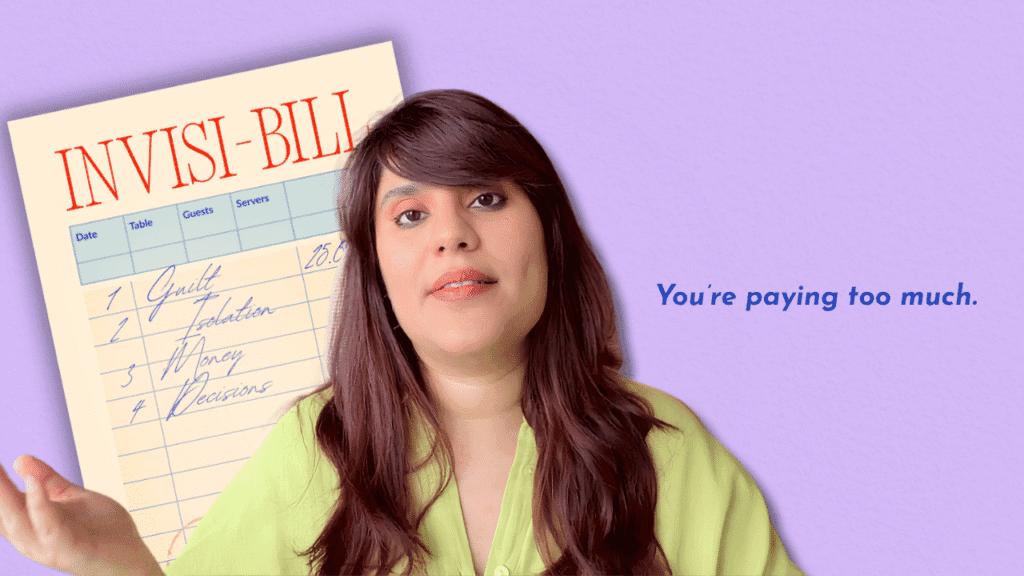
In this video, I break down 4 specific, everyday costs that clutter is quietly charging you — none of which show up as a line item until you sit down and actually look at the bill. Plus the one mindset shift that finally makes it possible to let go of the things you’ve never been able to.
If you prefer reading, the blog post continues below.
Hey, I’m Aastha. I spent 18 years in corporate before I started paying attention to what was quietly draining me at home. Eye of the Calm is where I write about clearing the chaos — from your home, your head, and your work — so you can build a life that actually feels like yours.
So. Let’s open the bill.
Item One: Amnesia with a Side of Amazon Prime
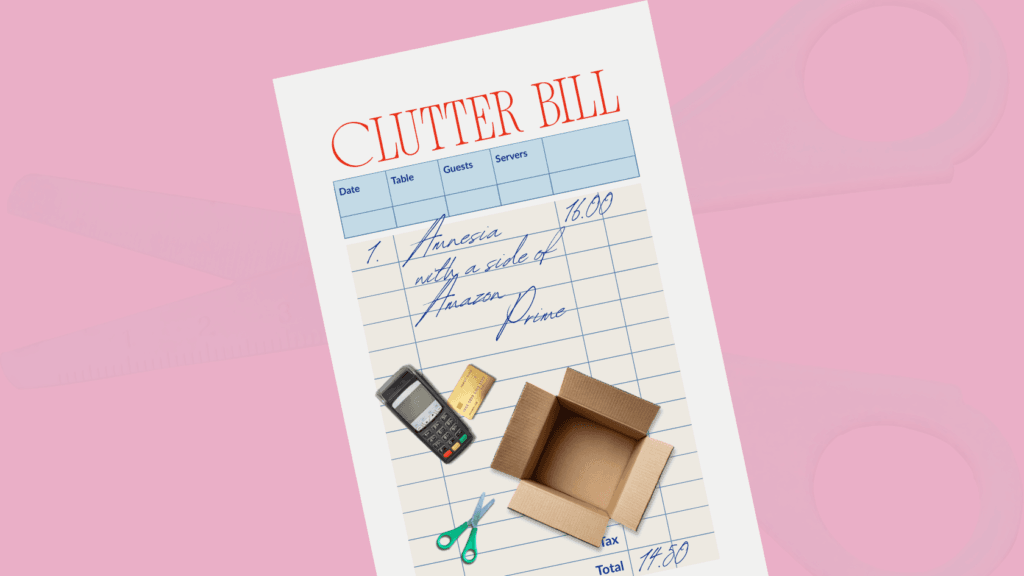
Tell me if this is familiar. You’re three clicks into checkout. A phone case — pink, little ring at the back. You know you own this exact phone case. You bought it four months ago, for this exact reason. It’s lying somewhere. And yet, here you are at 11:47 PM, buying it again like a woman with no memory and a saved card on file.
It’s like the third pair of nail clippers you ordered because the first two have taken themselves off to an alternate universe of nail clippers. Or the tape you bought when you couldn’t find tape — and then found three rolls of the same tape in a forgotten drawer.
Here’s what’s actually happening when that keeps occurring. When you can’t find what you own, your brain shops as if you own nothing.
A 2016 study in the Journal of Environmental Psychology measured this across 1,300 adults and found it was a consistent, documented pattern: people regularly buy things they already own because they can’t locate the original. Researchers actually built a scale around this, measuring clutter’s impact across financial, social, and emotional dimensions of daily life.
So clutter isn’t just taking up space in your home. It’s showing up in your bank statement.
Ledger entry: Convenience, paid for twice.
Item Two: Decision Paralysis with a Side of “I Have Nothing to Wear”
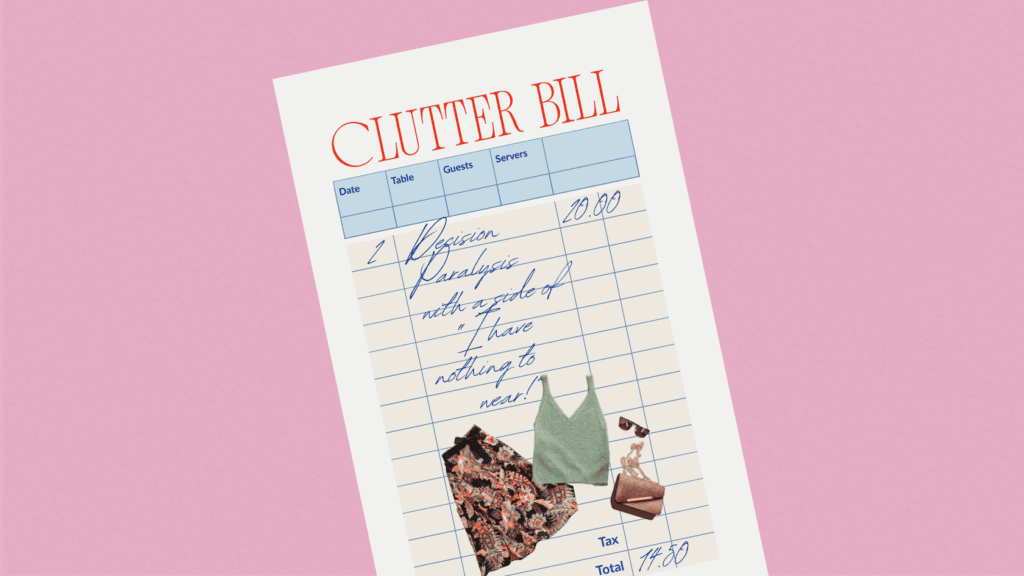
You’re standing in front of your closet. Twenty-something shirts. A coat for every kind of season, including the ones between the seasons. Shoes you forgot you owned. And yet somehow you’re saying, out loud, to no one in particular: “I have nothing to wear.”
It is the most universally understood lie in the English language.
Here’s what’s actually happening. Think of your ability to make decisions like a battery. Every choice you make drains it a little — whether it’s a big work call or what to have for lunch. That’s true for everyone.
What clutter adds is a constant background drain. Every pile you see, every thing that’s out of place, every “I’ll deal with this later” is quietly running your battery down in the background. By the time you open that stuffed closet, your battery is already lower than it should be. You’re not failing to pick an outfit. You’re running on empty.
And this hits harder for some people than others. Researchers at De Paul University and the University of California found that people already prone to hesitation get significantly more paralyzed by clutter than those who aren’t. Clutter doesn’t create indecision from scratch — it finds the tendency you already have and charges it more.
Ledger entry: An outfit that took eleven minutes not to pick.
Item Three: Isolation with a Side of “Let’s Just Meet at the Cafe Instead”
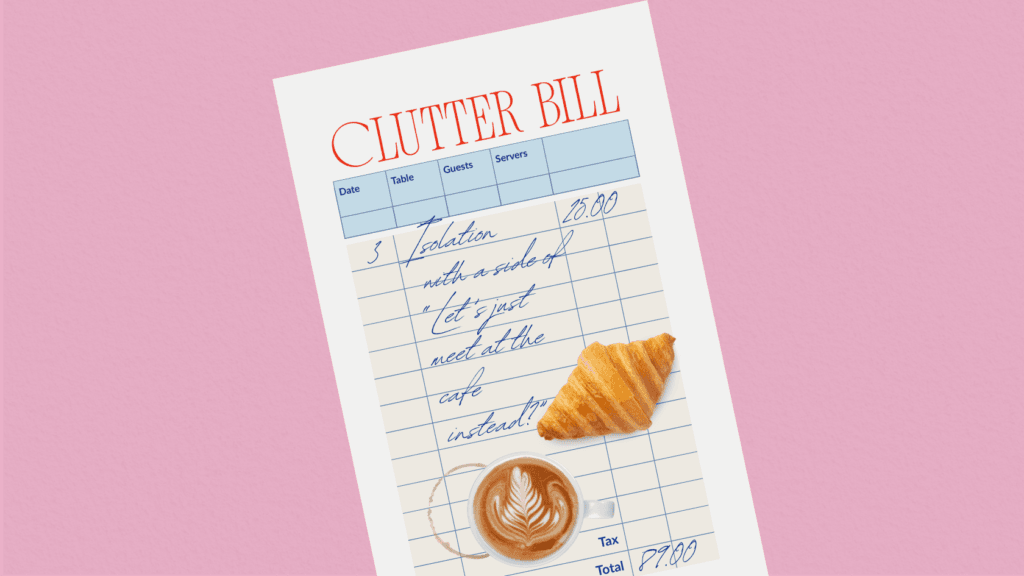
Your friend texts. She says she’s in the area, can she swing by in 20?
Before you’ve even typed back, you’re already moving. Sweeping the counter into a laundry basket. Stuffing the basket into a closet that doesn’t actually close properly. Fluffing a cushion over something you have no time to deal with. By the time she rings the bell, you’ve performed an entire renovation in 20 minutes and you open the door slightly out of breath, like you’ve just run a small secret marathon.
But it’s not just the scramble. It’s what shifts underneath it, quietly, over time.
Before you know it, your default becomes: “Hey, let’s just meet at the cafe instead.” You stop inviting people over as often — not because you don’t want them there, but because your home never feels ready. And somehow it never is ready.
The same 2016 study in the Journal of Environmental Psychology that measured the financial cost of clutter also measured this social one. It found enough people agreed with the statement “I avoid having people come to my home because of clutter” that researchers made it a distinct, measurable dimension in the study. This isn’t an edge case. It’s common enough to quantify.
Ledger entry: The dinner party you never threw.
Item Four: Guilt with a Side of Outgrown Childhood Values
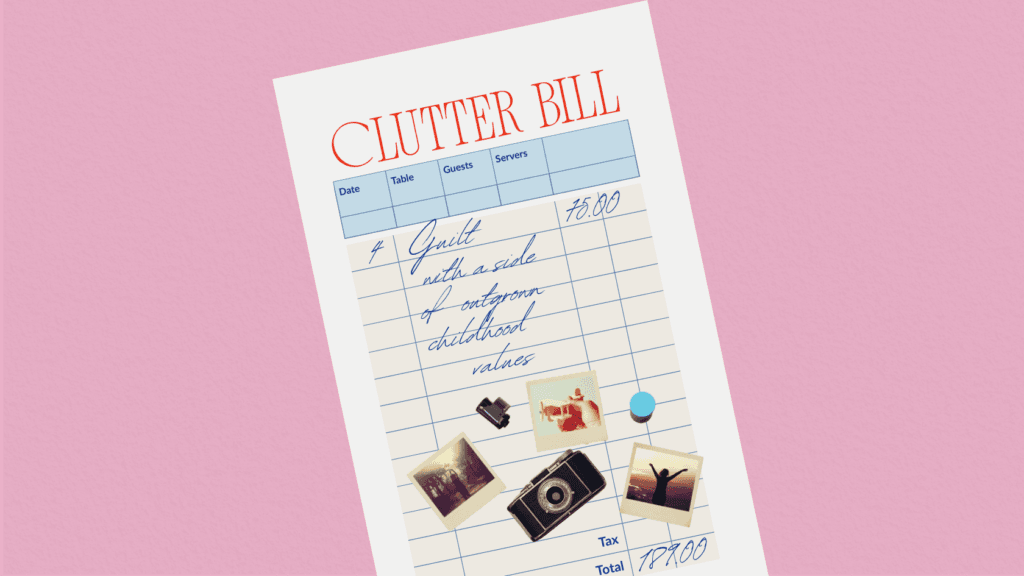
There’s a Pink Floyd T-shirt I have. It’s full of holes. At this point it’s about 60% cotton and 40% sentiment. I don’t remember the last time I wore it publicly. It no longer fits. And yet: it has a hold over me I couldn’t explain for years.
Here’s what I eventually understood. This was never really about the T-shirt.
I grew up watching my mother preserve things — old sarees, family heirlooms, pieces of art. In my family, there was an unspoken rule: you don’t throw things. You value them. You treasure them. I absorbed that instinct completely, because it came from people who had built things up from very little, and for whom holding onto what you had meant something real.
And then I moved out. Into small rental apartments where my closet had absolutely no idea about my family values and cared even less about them.
But the stuff I couldn’t bring myself to release stayed. And when I tried to let it go, I felt guilt — like I was betraying the value that raised me. Like I was letting go of part of what made me, me.
It turns out there’s a name for this in psychology. It’s called the extended self — the idea, developed by consumer psychologist Russell Belk, that our possessions aren’t just objects. They’re part of how we understand who we are. Letting go of something can genuinely feel like losing a piece of yourself — because in a real psychological sense, that’s what your brain is registering.
And here’s where this becomes an ongoing cost, not a one-time feeling. Once that guilt-and-self-extension pattern gets going, it spreads. You start applying the “I can’t let this go” instinct to more and more things. Slowly, your home fills with items you can no longer make a decision about. Every one of them is quietly occupying space — physical or mental — and adding to a bill that keeps growing.
Ledger entry: Guilt for the crime of changing.
The Mindset Shift That Changes This
So that’s the bill. Money. Mental energy. Your social life. Guilt. It’s a big, hefty ledger.
Here’s the thing about the guilt line item specifically — it’s the one that blocks everything else. Because you can intellectually know that the duplicate nail clippers are ridiculous, and still not be able to touch the Pink Floyd T-shirt.
The shift that actually works: you don’t have to choose between honoring where you came from and clearing your space. Those are not the only two options.
There’s a 2017 experiment in the Journal of Marketing that showed exactly this. Researchers asked two groups of people to donate things they were emotionally attached to — things that were genuinely hard to let go of. One group donated normally. The other group was asked to photograph the item before donating it.
That one small step — taking a photo first — made people about a third more willing to let the item go. The reason was simple: once the memory had a place to live, in the photograph, people didn’t need the object itself to hold it anymore.
The memory was never in the object. It was always in the person.
That Pink Floyd T-shirt doesn’t hold the value my mother taught me. I do. That value, that memory, lives inside me — and because I carry it, I don’t need the T-shirt to carry it for me. Once I understood that, I could finally let it go.
If You’re Stuck on Something Right Now
For the items that are hard to let go of — the ones where you’ve read all of this and you still don’t know what to do — I built a free tool for exactly that moment.
It’s called Let It Go, and it’s inside my free Trash Bag Therapy app. It asks you a few gentle questions, no guilt, no pressure, and then gives you a clear path forward for that specific item you’re struggling with.
Access the Let It Go tool free →
The Trash Bag Therapy guide is also there — a 20-minute system for getting visible results in your space fast, if the bill above has you ready to start doing something about it today.
So Now You’ve Seen the Bill
Money spent twice on things you already own. Decision fatigue draining you before you’ve made a single real choice. A social life quietly shrinking because your home never feels ready. And a guilt that was never really about the objects at all.
None of these show up as obvious line items. That’s what makes them so expensive.
If you’re ready to actually start letting things go — without becoming a minimalist, without throwing everything out, without a personality transplant — that’s exactly what the next post covers. (Coming soon — I’ll link it here once it’s live.)